Showing posts with label economy. Show all posts

Thursday, January 28, 2016

Battle over Cagayan de Oro airport: US base or new city center?

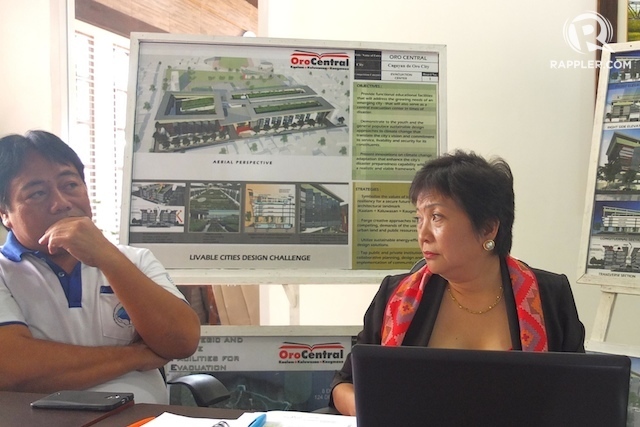
NEW CITY CENTER. Engineer Isidro Borja (left), Cagayan de Oro's top planning and development officer; and Eileen San Juan, the city's chief for Local Economics, Investment Promotion, discuss the planned Cagayan de Oro city expansion. Photo by Bobby Lagsa/Rappler.
NEW CITY CENTER. Engineer Isidro Borja (left), Cagayan de Oro’s top planning and development officer; and Eileen San Juan, the city’s chief for Local Economics, Investment Promotion, discuss the planned Cagayan de Oro city expansion. Photo by Bobby Lagsa/Rappler.

CAGAYAN DE ORO CITY, Philippines – Is there a looming battle over the use of the old Lumbia airport?
The national government is not the only one eyeing the old airport, reportedly for use by the US military under the Enhanced Defense Cooperation Agreement (EDCA). The Cagayan de Oro city government has also expressed interest in developing 106 hectares of prime airport property in Barangay Lumbia.
The city’s top urban planners, with the help of the United Architects of the Philippines, created the Planned City Expansion (PCE) in Barangay Lumbia, an expansive uptown village deemed suitable for expansion as it is not prone to flooding and has potential as the new city center.
Cagayan de Oro Mayor Oscar Moreno said the PCE was conceptualized under the United Nation Habitat’s Achieving Sustainable Urban Development (ASUD) project with the assistance of Arcadis, a global design, engineering, and management consulting company.
The PCE covers 820 hectares of land including the Lumbia airport which is now under the control of the Philippine Air Force’s 10thTactical Operations Group, though the land is owned by the Department of Transportation and Communications (DOTC).
New growth area
Moreno said that the prime land, which is 180 meters above sea level, is a strategic area since future expansions under the Mindanao Logistics Infrastructure network (MLIN) pass through or near lumbia.
The MLIN is a long-term development plan for the road network in Mindanao. It includes new construction, and the upgrade and improvement of existing national roads and local roads.
All agencies, including the Department of Public Works and Highways, should use the MLIN plan as a guide for their own long and medium term development plans in the area covered by the plan.
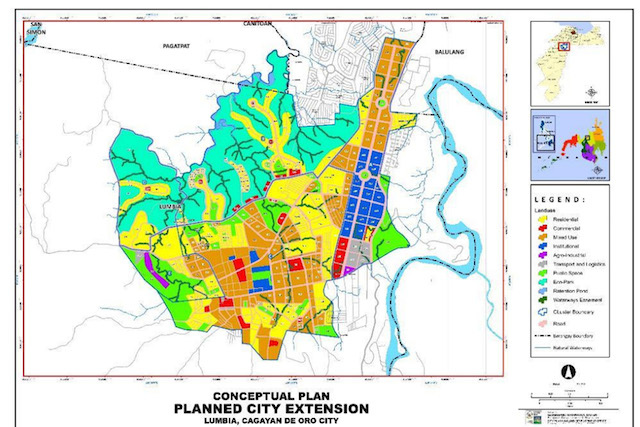
EXTENSION. The conceptual plan of the planned Cagayan de Oro city extension. Map courtesy of the CDO government
The MLIN is intended to be used as a reference for agencies involved in the development of the Mindanao transport network.
A new national road is being constructed that will connect Iligan City to Bukidnon.
Engineer Isidro Borja, chief of the City Planning and Development Office, said that the PCE will be the new growth area of the city with its cluster of areas for development.
“It is like a self-contained community where everything is there, without having to go to other places to work or study,” Borja said.
Last year, Christopher Rollo, ASUD country program manager for UN Human Settlement, said that if the expansion of the city is left unplanned and unchecked, it is likely to be driven by real estate market that favors development for the rich.
“In Lumbia, it is where everything can be put in place like public spaces can remain public, road network connected to other districts without being blocked by private ownership of lands,” Rollo said.
Mixed-use modern district
Eileen San Juan, the city’s local economics and investment promotions chief said that she met with defense officials on January 11, 2016, to present the city’s PCE, which includes the Lumbia airport.
Moreno said the PCE was presented to President Benigno Aquino III and Cabinet officials as early as 2013 as part of the city government’s bid to promote the city.
San Juan said that the PCE is an exercise in urban planning which the city badly needed.
Under the PCE, there are 5 proposed clusters – Lumbia airport is under Prime Cluster A where local and national government offices are located.
“We will also replicate ‘Plaza Divisoria,’ which is a unique feature not found in any other city,” San Juan said.
Plaza Divisoria is a strip of 5 parks with statue of national hero Dr Jose Rizal, Andres Bonifacio, president Ramon Magsaysay, and mayor Justiniano Borja who first planned the city’s business district which Divisoria will be part of.
San Juan said the city wants a strategic and sustainable development node, a model for adaptive reuse, providing rural areas easy access to economic opportunities and social services.
“We want an institutional landmark with wide public parks and open space in harmony with medium to high density residential and commercial development which would showcase the city for livability and resilience,” San Juan said.
Borja said the PCE conforms with the approved Comprehensive Land Use Plan (CLUP).
“With the diverse housing market, low, medium, high end suitability for resettlement, this project will answer the housing shortage in the city,” Borja said.
Clusters
San Juan said each cluster under the PCE is designed according to use.
  • Cluster A: Institutional and mixed use
  • Cluster B: Farmstead/homestead villages
  • Cluster C: Medium-density residential with community facilities, health and education, low intensity commercial area with at least 20% social housing with connection to town center and public spaces
  • Cluster D: Residential villages in terraced fields, water retention ponds, soil erosion control and tourism activities with ecotourism (biking, trekking, adventure sports), mountain view resort with convention and meetings facilities
  • Cluster E: Agri-processing Complex with waste management facility, mixed use Low–medium end housing, commercial, community facilities, value chain-considered efficient access to raw materials and markets

CLUSTERING. Cluster A is where local and national government offices would be located. Courtesy of the Cagayan de Oro city government

Borja said the PCE was designed considering road traffic. “All major roads will be 30 meters wide, while other roads will be at least 10 meters wide, both with provisions for pedestrian and cycling lanes.”
“We wanted the PCE is to be as walkable as possible; we want it to be environmentally and people friendly,” Borja added.
Adjustments
If EDCA enters into the picture and the airport is used by the US military, city officials said they would have to just adjust the design accordingly – but not without first exhausting efforts to convince the national government to favor the PCE.
Moreno said the long-term plan is for the common good.
“It is up to the national government if they’d allow the local government’s initial plan. We need them (national government) to cooperate because basically, the land belongs to to the Civil Aviation Authority and we cannot plan without them involved,” Moreno said.
Moreno added that the city government is taking steps to convince the national government on the expansion, as it is for the common good.
In its plan, residential areas will get 19.72% or 177.62 hectares; commercial area, 2.04% or 18.35 hectares; institutional 4.6% or 42.1 hectares; agro-industrial 2% or 17.87 hectares; mixed-used 15.8% or 142.9 hectares; commercial and transport facilities, 0.91% or 8.19 hectares; roads, 15.96% or 143.76 hectares; public spaces, 38.83% or 349.72 hectares.
“We will be expecting adjustments and needs to revisit the planning and resources needed to achieve our goal of the PCE,” San Juan said.  Rappler.com

Source: Bobby Lagsa/ http://www.rappler.com/nation/120224-battle-lumbia-airport-us-base-cagayan-de-oro-city-center

9 trending local cities this year

Property analysts and experts forecast that developers will continue to pursue township developments in and outside Metro Manila in 2016. Now, where could these, and other types of developments be? Here are the nine likeliest urban locations:

1 Cavite. Colliers International Philippines cites three reasons Cavite is on developers’ maps:
  • Cavite has been known as a suburban support area to Metro Manila. With its relatively cheaper housing costs, Cavite has drawn within its boundaries hundreds of thousands, who still commute daily to their workplaces within Metro Manila.
  • Numerous infrastructure projects recently launched will allow Cavite to flourish. The LRT-1 extension project will end in Bacoor; the government has now started the bid for LRT-6 which will further extend the LRT line from Bacoor to Dasmariñas City. Furthermore, the 44-kilometer Cavite-Laguna Expressway (Calax) project will provide necessary access to growth areas in Cavite.
  • With the completion of the Muntinlupa-Cavite Expressway (MCX), a toll road which connects the South Luzon Expressway (SLEx) to Daang Hari, property values in the area are foreseen to escalate rapidly. The new toll road will spur rapid development in emerging master-planned communities such as Vista Land’s Vista City and Ayala Land’s Vermosa Estate, which have the potential to establish themselves as full-blown central business districts (CBDs).
Property portal Lamudi Philippines, in its 2016 top cities list, shares eight more locations that will benefit from real estate investments.

2 Quezon City. The population of Metro Manila’s largest city is projected to grow to more than 3.5 million by 2020, with many looking into relocating there. Quezon City properties are relatively more affordable compared to Makati and Taguig, and offers plenty of options to homebuyers.

3 Makati. The country’s foremost financial and business district won’t be outdone, even if the average rental rate in its CBD is expected to decrease 3.39 percent year-on-year by the third quarter of 2016, vacancies to increase to 10.19 percent across all condo grades. Fringe areas, however, are starting to see an uptick in real estate activity, particularly Barangay San Antonio, near Ayala Avenue. “Worsening traffic conditions in Metro Manila are making these areas attractive to renters and homebuyers,” said Lamudi.

4 Taguig. “Taguig’s population is projected to reach almost one million by 2020, which will make it the National Capital Region’s fourth more populous (after Quezon City, Caloocan and Manila) and the country’s 9th. The city’s real estate sector has been on an upswing ever since Fort Bonifacio was privatized,” noted Lamudi. It added that several projects now are underway: Megaworld’s McKinley West and Ayala Land’s Arca South. Access to and from the airport (particularly Terminals 1 and 2) and to Coastal Road will also improve when the flyover connecting CP Garcia Avenue to the Moonwalk Access Road and West Service Road is finally completed.

5 Pasay. This city is gaining prominence because of: 1) Bay City—the reclamation area along Manila Bay housing the Mall of Asia Complex, Entertainment City—and Aseana City; 2) The SM group has already incorporated office and residential components in the MOA complex; 3) Federal Land is set to complete its Six Senses Residences in 2016 and its first tower in the Palm Beach project in 2017; 4) Improved infrastructure when the Naia Expressway connecting the Metro Manila Skyway to the Manila-Cavite Expressway and Entertainment City, is finally completed.

6 Bacolod. In mid-2015, Lamudi data showed that Bacolod had become among the most popular cities among online property hunters. In fact, real estate giant Megaworld announced in late 2015 that it was building two integrated townships in the city (the 50-hectare Northill Gateway and the 34-hectare The Upper East), while Ayala Land has sealed an agreement with the provincial government of Negros Occidental to build the mixed-use Capitol Central.
7 Davao. Davao remains southern Philippines’ economic and business center, and one of the most searched cities in the Lamudi website in 2015. Its population is projected to balloon to 1.83 million by 2020. Davao is also consistently among the most searched by online property hunters, and the sixth and third most searched city by property hunters based in the United States and Saudi Arabia, respectively, according to Lamudi data.

8 Cebu. Cebu City is one of Tholons’ top 10 outsourcing destinations in the world (and second in the Philippines behind Metro Manila). According to CB Richard Ellis Philippines, exciting expansions and new developments are coming in over the next few years. In 2015 alone, two new large malls opened in the city, SM Seaside City Cebu and Robinsons Galleria Cebu. SM Seaside alone has an area of 10-15 hectares devoted to commercial development, similar to the E-com office towers in the MOA complex, while Robinsons Galleria will have entire floors dedicated to BPO offices.

9. Muntinlupa. The south of Metro Manila, specifically Muntinlupa, is also projected to perform well this year, with the launch of several high-profile projects from the country’s biggest developers, one of which is Avida’s South Park District, a mixed-use development sitting on the former Nestlé plant in Alabang, in addition to the established Filinvest and Madrigal business districts. Further, in anticipation of infrastructure projects expected to ease travel to the south, property developers, including Rockwell subsidiary Rockwell Primaries, and Vista Land are now eyeing Muntinlupa as their next focus area.

Source: By: Tessa R. Salazar http://business.inquirer.net/206043/9-trending-local-cities-this-year

Tuesday, January 26, 2016

Elections to affect real estate activity; oversupply in vertical residential segment

AS THE PHILIPPINES “goes bananas” in an election year—in the year of the monkey at that—property experts see a number of challenges, and likely trends, flavoring and coloring the real estate industry in 2016. Here’s their fearless forecast:
  1. There will be an oversupply in the mid-market vertical residential segment.
“I expect 2016 to be the most challenging year for the residential property sector. A looming oversupply in the mid-market vertical residential segment in Metro Manila is developing, and developers should expect a slowdown by as much as 10 percent in the average annual take-up rate of 50,000 units. Several developers are already holding back sales of new projects until supply balances out in 2018,” said Enrique M. Soriano III, Ateneo program director for real estate and senior adviser for Wong+Bernstein Business, in an Inquirer Property interview.
Soriano said that with this oversupply scenario, “we will naturally anticipate vacancy rates to go up in 2016 to double digits in the Makati and Ortigas CBD (central business district) area.”
  1. The 2016 presidential elections will affect the market. Soriano said the presidential and national elections “is likewise expected to freeze any major real estate activity in the first two quarters of 2016. Naturally, investor sentiment will be on a wait-and-see attitude. This will not bode well for the property sector and the economy as a whole. Hopefully, after the elections, it will be followed by a possible uptick in transaction levels in the last two quarters of 2016,” said Soriano.
  1. Business process outsourcing (BPO) growth continues. BPO companies, according to property portal Lamudi Philippines, will continue to buoy Metro Manila’s commercial real estate.
“Experts do not foresee the supply of office space surpassing demand soon, meaning commercial properties (and offices in particular) remain a beneficial investment for 2016,” said Lamudi
Philippines in a statement.
Soriano said that in 2016, Grade-A office rents in prime areas is expected to increase 5 percent, given strong demand for office space and low vacancy rates. Meanwhile, rents in non-CBD areas may slightly drop by 5 percent due to available supply in Makati and Bonifacio Global City.
  1. Metro Manila land values will go up. Lamudi Philippines said that despite slower gross domestic product growth in 2015, land values still continue to appreciate, albeit at a slower pace.
Colliers International said that growth rates of land values in Metro Manila accelerated in the second quarter of 2015. In addition, land values in the Makati CBD, growing at only 0.85 percent during the first three months of the year, rebounded in the next three by growing at a rate of 2 percent. This raised the area’s average price to P452,704 per square meter. Values similarly rose in the business districts of Fort Bonifacio and Ortigas Center, increasing at 1.97 and 2.1 percent, respectively.
  1. Retail property market will face a slowdown. Soriano said “the challenging retail environment is likely to persist next year due to diminishing inbound tourist arrivals. We expect prime rents outside of the shopping centers to slide by 10 percent in 2016, while shopping mall spaces are expected to escalate.”
“We can also expect a decline in premium retail market rents due to the expected drop in tourist arrivals as a result of the national elections happening in the first half of 2016. The mass retail market is expected to remain resilient as domestic consumption continue to grow, fueled partly by election spending nationwide,” said Soriano.
Source: by Tessa R. Salazar / http://business.inquirer.net/204872/elections-affect-real-estate-activity-oversupply-vertical-residential-segment

Thursday, January 21, 2016

Construction in full swing: Commercial sector shows no signs of slowing down as developers off to a strong start this 2016

IF the latter part of 2015 and the first quarter of this year would be any indication of how busy and vibrant the entire 2016 will be for the Philippine real-estate sector, it would be safe to say that we’re likely bound to surpass the milestones of the past year.
While the residential sector has been reaping the fruits of continued investments over the past few years, players within the commercial development sector, most notably, are now starting to enjoy an increasing growth momentum as more and more developers venture outside of Metro Manila.
ArthaLand and Robinsons Land Corp. (RLC), for example, have both began strengthening their presence in Cebu, which has earned the reputation as the most vibrant investment destination in the Visayas. ArthaLand plans to promote its sustainable building culture by putting up an “energy-efficient and environmentally sustainable office building” also in Cebu City. The company recently acquired a property in Cebu via its subsidiary, Cebu Levana Land Corp., and plans to offer approximately 51,000 square meters of office space for the region’s offshoring and outsourcing sector (O&O) players.
Meanwhile, the latest Philippine Property Market Monitor from Jones Lang LaSalle reported that RLC is set to inaugurate an office building in Cebu City, which will take up about 30 percent of its 4.6-hectare property that also houses the recently opened Robinsons Galleria Cebu. This is deemed to be a welcome development for commercial locators in Cebu, particularly for those engaged in its O&O, as the facility will be offering a GFA of close to 9,500 sq m.
Booming growth beyond Metro Manila
Back in Luzon, developers are also keen on building the next thriving investment districts outside of Metro Manila. In Clark at Northern Luzon, construction activities will likely hit a record high in the months to come following the recent announcement of two massive development projects: Global Gateway Development Corp.’s (GGDC) Aeropark Campus and the 35,000-hectare Clark Green City.
The $150-million Aeropark Campus, one of the more remarkable investments initiated by Kuwaiti investors GGDC, promises to be a major development that will help shift the focus of growing industries away from Metro Manila. The project, which will host more than 5.8 million sq m of premium office, logistics, retail, hotel and residential space, is expected to generate at least 10,000 jobs during the first few years of its operations. That number is seen to balloon to at least 300,000 jobs once the entire project is completed. Clark Green City (CGC), meanwhile, is seen to lure more foreign investors as state-owned Bases Conversion and Development Authority (BCDA) continues to facilitate development for the 9,450-hectare master-planned property inside the Clark Special Economic Zone. Once completed, the entire CGC has the potential to generate a gross output of at least P1.57 trillion annually, apart from facilitating the continued growth of more areas in Northern and Central Luzon.
Supply more than meets current demand
The abundance of office spaces in other areas within Metro Manila continues to complement the increasing demand and confidence of local and foreign investors.
A recent insight shared by experts from Jones Lang LaSalle revealed that, as we speak, there’s a total of 1 million sq m of available office space spread out among areas like Makati City, Ortigas, Bonifacio Global City, reclaimed areas in Manila Bay, and Alabang in Muntinlupa. Of this grand total, at least 15 percent to 20 percent will be taken up by business-process outsourcing (BPO) companies, as established firms expand their operations and new players come in. All of these developments confirm the earlier analysis made by Lamudi Inc. Founder and Managing Director Jacqueline van den Ende, who was among the thought leaders I spoke to for one of my trend reports prior to the end of 2015. “Developers are looking to go provincial due to the increasing scarcity of available land.
A couple of very big projects are being launched, especially in Cebu and in other provinces.…The office market in Manila will continue to be very strong. We see a lot of strata-titled office developments launched this year, which I think will be huge in 2016. Metro Manila’s office market is tight with very few properties coming online.
This is especially true in non-BPO-type offices. This presents an opportunity for investors.” We’re definitely on the lookout for how all these exciting developments will shape up this year. Great times ahead, everyone!

Source: http://www.businessmirror.com.ph/construction-in-full-swing-commercial-sector-shows-no-signs-of-slowing-down-as-developers-off-to-a-strong-start-this-2016/

LESSONS LEARNED IN 2015

Property portal Lamudi said  2015 was a good year for Philippine real estate. 

In the first part, we gave a rundown of 12 of the 25 lessons in property development in 2015.

The remaining 13 are as follows:

13.  Forbes Park is the most expensive subdivision in the Philippines
Average monthly rents in the very exclusive Forbes Park—home to business tycoons, foreign dignitaries, and boxing icons—stand at Php402,459, making the enclave the most expensive area to rent a
house anywhere in the Philippines.

15. Filipino-Americans prefer houses
Despite the condo boom happening in Metro Manila and other major cities across the Philippines, it seems that many Filipinos based in the United States still prefer to purchase houses, at least according to
January–June 2015 search data from Lamudi. More than half (57.83 percent) of all searches in the Lamudi website were for houses, followed by condos (16.58 percent). The most searched cities? Quezon
City, Makati, Manila, Tagaytay, and Baguio, in this particular order.

16. Cities affordable for first-time homebuyers
There are cities surrounding Metro Manila abound with affordable options for first-time homebuyers. These cities include San Jose Del Monte, Bulacan, where average home price stands at Php495,999; and followed by San Mateo, Rizal (Php549,259); Dasmariñas, Cavite (Php1.189 million); Imus, Cavite (Php1.858 million); Bacoor, Cavite (Php2.777 million); Antipolo, Rizal (Php3.668 million); Santa Rosa, Laguna (Php4.16 million).

17. Condos close to train stations are more expensive
An average condo located within 100 meters of an MRT station is at least Php16,645 more expensive per square meter than a similar, newly built condo situated more than 500 meters away, according to
listings data from Lamudi.

18. Ayala Center, Century City, and Rockwell Center lead most expensive list
Ayala Center—the commercial core of the Makati CBD—commands the most expensive condo rent per sqm than any area Metro Manila. Living in the area, which is within striking distance of Greenbelt, Glorietta, and most of Makati’s luxury hotels, can set a renter back Php1,144 per sqm per month, meaning a 100-sqm condo here can command monthly rent of more than Php110,000. Following Ayala Center are Century City and Rockwell Center in Makati’s Poblacion area, where condos command monthly rents 
of Php986 and Php973 per sqm, respectively.

19. Pricier condos are not necessarily bigger
On a per-square-meter basis, more expensive condos do not necessarily mean bigger space. Areas where condos are on average bigger are actually cheaper on a per-sqm basis. These areas include Ayala Triangle/Apartment Ridge, where condos average 275 sqm and where monthly rents average Php568 per sqm. This area is followed by Salcedo Village, where the average size of condos is 126 sqm and average monthly rent stands at Php652 per sqm. In contrast, in the Mall of Asia Complex and Newport City, the average sizes of condos are 34 and 50 sqm, but monthly rents average Php850 and Php785 per sqm, respectively.

20. Caloocan will be the second most populous city by 2020
The City of Manila will be overtaken by nearby Caloocan as the Philippines’ second most populous city by 2020. This is according to an analysis by Lamudi using the annual average population growth rate issued by the Philippine Statistics Authority in 2010. Caloocan’s projected 2020 population will be 1.88 million, compared to Manila’s 1.72 million.

21. Eleven PH cities will have populations of more than 1 million by 2025
Using the annual population growth rates recorded in 2010, 11 cities in the Philippines are projected to have populations of more than 1 million. These are Quezon City (3.95 million), Caloocan (2.115 million), Davao City (2.056 million), Manila (1.76 million), Dasmariñas (1.27 million), Antipolo (1.25 million), Zamboanga City (1.25 million), Cebu City (1.14 million), Taguig (1.12 million), Bacoor (1.11 million), and Pasig (1.022 million).

22. Can BPO workers afford condos?
With an average monthly salary of Php22,500, entry-level customer care representatives cannot afford to rent a condo in either of these “affordable” areas: Eastwood City, Pioneer-EDSA, Poblacion (Makati), and San Antonio (Makati), where average rents range from Php19,838 to Php22,563 per month. Using the 30 percent rule (spending not more than 30 percent of one’s monthly income on housing), only those working as managers, with an average compensation of Php75,000 per month, may only afford to rent a condo in these select areas.

23. How long Filipinos should work to buy a home
A salaried Filipino with more than 20 years of work experience and earning Php1.43 million per year may need 128 years’ worth of his salary in order to afford a house in Makati where average home price stands at Php184 million. In contrast, this same person needs 4.16 months’ worth of his annual salary in order to afford a home in San Jose Del Monte, Bulacan, where the average home price is Php495,999.

24. Are Filipinos buying or renting?
Based on its third quarter 2015 search data, Lamudi found that there is an almost equal proportion of renters and buyers among 18- to 24-year-old online property-hunters (50.2 percent for rent versus 49.8 percent for sale). Quite interestingly, there is a tendency for property-hunters to check out for-sale properties online as they get older. Among 25- to 34-year-old users, 57.3 percent are checking out for-sale properties. In the 35–44, 45–54, and 55–64 age groups, it is even higher; 70.8, 72.6, and 71.1 percent of the website’s users, respectively, are checking out for-sale properties.

25. Most sought-after locations for land
Quezon City, Tagaytay, and Baguio are the top three most popular locations among property-hunters looking for land online. These cities are followed by Davao and Antipolo. “Clearly there are cities preferred by people researching about land for sale online, and we hope these findings will give real estate developers insight into how to properly plan their next projects,” said Lamudi. In addition, the fact that only five Metro Manila cities were in the top 10 indicate that Filipinos are not too keen into buying residential land within the National Capital Region, either due to lack of supply, unaffordability, or both.

Source: http://www.malaya.com.ph/business-news/special-features/lessons-learned-2015

PROPERTY SECTOR GROWTH SLOWDOWN SEEN

Brokerage firm Colfinancial.com  sees a slowdown in the property sector in 2016 after years of robust expansion.

The online brokerage firm noted this is particularly true in the residential market.

“Take-up sales of residential properties continue to grow annually. However, the pace of growth has been slowing down since 2014 given the high base effect,” it said. 

“This year, we expect growth to remain slow as take up sales in 2015 remain substantial. Aside from high-base effect, as risk to growth this year is the slowing growth of OFW remittances,” it added. 

Colfinancial.com noted that in the first 10 months of last year,  remittances from overseas Filipinos increased by only 3.7 percent to $20.6 billion from an average of around 7 percent in the past five years.

 This should a big consideration in the property market, according to the brokerage firm, given that the average contribution of OFW sales to take-up sales is around 31.5 percent. 

“Another possible, albeit small, risk to demand is higher interest rates. Local bond yields have increased following the rate hike by the Federal Reserve of the United States in December of 2015 and
expectations of more rate hikes,” Colfinancial.com said.

 “However, according to our banking analyst, lending rates are not expected to mirror the increase in bond yields due to ample liquidity conditions and intense competition among banks. Moreover, the Federal

Reserve has repeatedly said that the rate hike cycle will be slow,” it added.

 Colfinancial.com said any increase in lending rates will be very small and not enough to significantly dampen demand for real estate. 

The brokerage firm also assured that the risk of a glut is low.

 “For the first nine months of 2015, takeup sales of leading property developers outpaced launches. This indicates that sales are not primarily driven by new launches and that there is enough demand to
absorb developers’ existing inventory. This also indicates that developers are disciplined enough to continuously monitor the demand- supply situation and are careful not to flood the market with supply,” it
said.

 The office space segment meanwhile continues to benefit from the good prospects of the business process outsourcing sector. 

“The depreciation of the peso last year also gives international companies greater incentive to move backroom operations to the Philippines,” it added. 

Colfinancial.com said the growth in demand will be able to absorb incoming supply. 

“According to Colliers, office supply will grow at a CAGR (compounded annual growth rate) of 8 percent from 7 million sq uare meters in 2014 to 9.5 million sqm by 2018. Meanwhile, IBPAP (Information

Technology Business Processing Association of the Philippines)  expects the BPO (business process outsourcing) sector to have 1.3 million full-time employees by 2016, up by a CAGR of 14 percent from 1 million in 2014,” it said.

 “Even if growth rate of full-time employees drops to half in 2017 and 2018, we believe it will still be enough to fill the incoming supply,” it also said.

 Colfinancial.com meanwhile said outlook for the commercial leasing segment remains positive as retailers continue to expand, creating demand for retail space. 

“The improvement in the economy is also resulting to an increase in the number of casual dining outlets. Economic growth and stability has led to the increase in the frequency of people dining out rather than
eating at home, thus creating demand for more casual dining outlets. This serves as a big driver of demand for commercial space,” it said. 

“With this in mind, we expect vacancy rates to remain low and same store/ mall sales to remain on an upward trajectory,” Colfinancial.com added.

Source: By ALBERT CASTRO  / http://www.malaya.com.ph/business-news/special-features/property-sector-growth-slowdown-seen

Tuesday, January 19, 2016

Iloilo and Bacolod emerge as top Tier 3 sites for outsourcing firms

WHILE India and the Philippines remain the top countries for offshoring, an A.T. Kearney study revealed companies are looking to locating in Tier-3 sites outside these nations’ capitals.
“While India and the Philippines are still top of mind when it comes to offshoring, the hunt for new talent is now taking companies beyond these countries’ capitals and major cites to Tier-3 locations, such as Surat, Nagpur, and Lucknow in India; and Bacolod and Iloilo City in the Philippines,” A.T. Kearney’s New York partner Arjun Sethi was quoted in a news statement as saying.
Sethi based his statement on the recently released 2016 Global Services Location Index (GSLI) by the management consulting firm. The report shows India and the Philippines unchanged in the index from the 2014 ranking at No. 1 and No. 7, respectively.
A.T. Kearney ranks countries to arrive at its GSLI according to financial attractiveness (FA), people skills and availability (PS&A) and business environment (BE).
India’s FA score of 3.22, while lower than Indonesia—also unchanged at No. 5, is still higher than the Philippines’s 3.17 score. The Philippines’s PS&A score of 1.43, while higher than Malaysia’s 1.42 score, pales in comparison to India’s 2.55 PS&A score. Malaysia and China, to note, also remained unchanged from their 2014 ranking of No. 2 and No. 3, respectively.
But the Philippines’s BE score of 1.29 beats India’s 1.19. “Since the 2014 GSLI, the Philippines has registered gains in its scores in infrastructure, environment and tax and regulatory costs,” the report, titled “On the Eve of Disruption,” said.
The report added that companies are looking at Tier-3 cities in the Philippines as location for offshoring because of the advantages these sites offer. “One advantage of Tier- 3 cities is the relative affordability of real estate. Another advantage is the relative availability of labor, its lower cost and lower attrition rates,” the report said.
Now on its seventh edition since 2004, the 2016 GSLI “helps companies make key location decisions for offshoring and industry development projects with objective guidance,” A.T. Kearney said.
The 55 countries in the 2016 index—four new countries have been added this year—are selected based on corporate input, current remote services activity, and government initiatives to promote the sector, the consulting firm added.

Source: By Daphne J. Magturo / http://www.bworldonline.com/content.php?section=Economy&title=bpos-in-smaller-cities-keep-phl-competitive—-a.t.-kearney&id=121530

Tuesday, January 12, 2016

No real estate bubble – BSP


MANILA, Philippines - Initial results of stress tests conducted by banks validated the assessment made by the Bangko Sentral ng Pilipinas (BSP) that there are no risks from the real estate market.
BSP Deputy Governor Diwa Guinigundo said initial results of the real estate stress tests conducted by banks showed the capital adequacy ratio (CAR) of banks would remain above the central bank requirement even if 25 percent of their real estate loan portfolio turns sour.
“At this point we don’t see any signs of stress in the real estate sector,” Guinigundo said.
The central bank has asked banks to submit data on their real estate portfolio to include exposure in socialized housing as well as debt incurred through the issuance of bonds to finance real estate activities.
“We now have a more comprehensive definition of the exposure to real estate. It’s more dependable,” he said.
Based on the new definition of the exposure of banks to real estate, Guinigundo said stress tests conducted by big banks showed that their CAR would still be above the 10 percent requirement set by the BSP and the eight percent threshold set under the Bank for International Standards (BIS).
“Even if they factored in a 25 percent souring of the loans on real estate, they are still above the 10 percent regulatory capital that we imposed on the banks,” Guinigundo said.
Aside from the BIS methodology, he said the BSP also used the International Monetary Fund (IMF) identification of asset bubbles.
“Those two tests will show that we are far from the so-called danger level,” he added.
The CAR of big banks stood at 15.48 percent on a solo basis and 16.42 percent on a consolidated basis as of end-June last year reflecting their continuous efforts to maintain adequate capital buffer against unexpected losses that may arise during times of stress.
The BSP stepped up its watch over the real estate sector as early as 2012 by ordering banks to disclose more comprehensive reports on their exposures to property industry.
The pre-emptive macroprudential policy measure approved by the BSP required stress tests for banks to determine if their capital will be enough to absorb credit risk that may arise from their exposure to the property sector.
Banks’ exposure to real estate jumped 21.8 percent to P861.22 billion in end-November from P708.88 billion in end-September last year. The sector accounted for 17.5 percent of banks’ total loan portfolio of P4.91 trillion as of end-November.
The BSP has set the cap on real estate loans at 20 percent of the bank’s total loan portfolio.
Guinigundo added that real estate developers are now more prudent after learning their lessons during the Asian financial crisis in 1997.
“We can also say that we are in touch with various real estate developers, the bigger ones, and it is very comforting to know that our developers have become more prudent, more discreet with respect to their expansion plans,” he said.

Source:  (The Philippine Star) / http://www.philstar.com/business/2016/01/12/1541553/no-real-estate-bubble-bsp?nomobile=1

Residential, office markets expected to continue stellar performance in ’16

WHILE 2016 has just begun, preparations are now being made to hail the Year of the Fire Monkey with a bang, when the Chinese celebrate their lunar New Year on February 8.
The whole nation is thrilled on what lies ahead this year, particularly on the political front, since this will mark the denouement of the Aquino administration and a new leadership will take over Malacañang Palace for the next six years.
With the national polls heating up, however, the economy and its growth-driving industries, especially real estate, are expected to weather the political noise.
Philippine economic development is seen in the expanding property sector as housing projects, commercial centers, workplace buildings, hotel and gaming facilities, as well as economic zones are being built one after the other not only in Metro Manila area, but also in other parts of the country.
This trend is seen to continue across all real-estate industry segments this year and beyond, most notably in the residential and office sectors.
Residential market
THE perennial housing backlog keeps on pushing the residential market’s growth, as the National Economic and Development Authority estimated the need of Filipinos for a “decent roof” is pegged at around 800,000 units per annum.
Since close to 400,000 households or almost half can still afford to buy dwelling units annually, this segment of the real estate remains the most competitive and profitable at present.
The towering heights of opportunity for both the developers and buyers still abound in vertical projects or condominiums.
In fact, the condo market accounts for the biggest share of all licenses to sell at 27 percent, according to the nine-year average of Housing and Land Use Regulatory Board (HLURB) data.
Leading the pack of developers is the SM Group, which intends to sell an annual average of 20,000 units starting 2016.
This initiative solidifies the Sy family’s market share in the condo space, said Pinnacle Real Estate Consulting Services Inc. Director for Research and Consulting Jojo Salas.
In their recent Market Insight Report, he also noted DMCI Group’s announcement that it would launch nine projects this year, with 14,000 units and estimated sales value of P50 billion.
The Consunjis also intend to generate recurring income when it launches its 36-story office project along Pasong Tamo in Makati City.
This will offer more than 40,000 square meters (sq m) of leasable area, subject to approval of permits and licenses.
Salas said the Ayala Land Group and Ortigas and Co. have packaged their housing projects with mixed-use and township developments.
Other developers are also ramping up the kick-off and completion of their projects to meet the predicted demand.
Lamudi Philippines reported that Century Property is on track to finish the construction of its luxury residential condo—the Trump Tower—by December.
Once completed, this 56-story tower in Makati City, composed of over 250 units, is the first Trump-branded condo not only in the country, but in Southeast Asia.
The property web site also revealed the scheduled opening this year of high-end 67-floor tower Shang Salcedo Place, which houses 749 units and top-class amenities.
Apart from condominiums, other residential types also offer good business and investment potentials for both the players and end-users.
Like vertical housing projects, economic housing comprises 27 percent of all licenses to sell, based on HLURB figures.
Meanwhile, socialized dwellings, as well as open-market subdivisions and townhouses account for 24 percent and 22 percent, respectively.
Pinnacle’s report shows the Ayala Group has focused on the economic housing by strengthening its projects under the Amaia brand.
It’s timely given the recent hike of the loan limit for this type of residence from P1.25 million to P1.7 million, as approved by the Housing and Urban Development Coordinating Council.
As for the socialized market, Bella Vista brand has been playing in this category, the study added.
Office segment
AS the economy surges, there’s still more room for expansion in the office sector of the real-estate industry.
Jones Lang Lasalle (JLL) Managing Director for Singapore and Southeast Asia Chris Fossick said new office supply is expected to be high in Manila in 2016 at 870,000 sq m, growing by 10 percent to 20 percent.
He said that most of the new buildings are in the central business districts (CBDs) of Makati and Bonifacio Global City (BGC) in Taguig, where there has been a shortage.
This year’s supply until 2018, however, is close to the five-year historical take-up from 2011 to 2015.
With the projected spike in the office-space inventory, a moderate hike in rental rates is likewise projected—this time at 4 percent, as 18 percent of the new supply in 2016 has been already precommitted.
This trend could still be attributed to the ever-expanding business-process outsourcing (BPO) industry, as some locators are moving up the value-chain and require more centrally located premises, Fossick said.
Based on data from the Philippine Statistics Authority, the office segment accounts for 29.4 percent of the real-estate demand in the country, largely driven by BPO at 11.3 percent.
Industry sources see the outsourcing sector to generate $25 billion in total revenues by end of the year.
Given the top figure, the BPO industry is projected to soon overtake dollar remittances by overseas Filipino workers, most likely in two years, according to an HSBC economist in a recent briefing. Job-wise, it is targeted to hit 1.3 million full-time employees in 2016, which translates to 5.2-million-sq-m office requirement.
Hence, the industry is now gearing up the “Next 10 Cities,” such as Baguio, Davao, Dumaguete, Iloilo, Lipa, Metro Bulacan (Baliuag, Calumpit, Malolos City, Marilao and Meycauayan City), Metro Cavite (Bacoor City, Dasmariñas City and Imus City), Metro Laguna (Calamba City, Los Baños and Sta. Rosa City), Metro Naga (Naga City and Pili), and Metro Rizal (Antipolo City, Cainta and Taytay).
Investment opportunities
AT the start of the new year, many of those planning to move to a new home or considering buying a property must be wondering what 2016 could bring to them.
In view of this, Lamudi Philippines takes a look at what are potentially good real-estate investment deals in the market today.
For one, Strata-titled offices are a good take, according to the real-estate portal.
Contrary to the BPO office towers constructed and rented out by property developers to outsourcing firms, they can be purchased by individual investors and buyers to lease to companies.
For those who want to diversify their investment portfolios, this property type makes a good business sense since there is a lack of supply of office space in the metropolis, particularly in major CBDs, placing an upward pressure on rental fees.
What’s more, the decreasing land-bank options in Makati City, BGC and Ortigas Center are also raising capital values of office buildings, based on Colliers International’s third quarter 2015 report.
Some of the strata-titled developments now available in the market are Alveo Financial Center along Ayala Avenue, which has 363 units and sells on average P223,000 per sq m; The Stiles in Circuit Makati (also of Alveo Land), with 283 units for P198,000 per sq m; Century Spire in Century City (Century Properties), with 283 units for P203,000 per sq m; Capital House in BGC (Avida Land), with 222 units for P142,000 per sq m; One World Place in BGC (Dai-ichi Properties), with 283 units for P136,000 per sq m; and Parkway Corporate Center in Alabang (Filinvest Land), with 390 units for P168,000 per sq m.
Apartments and townhouses are also worth investing in as they are two of the most searched property types by Filipinos at present.
Location-wise, suburban areas like Quezon City, Parañaque and Las Piñas are a top choice among the would-be investors.
Such properties are very in demand among renters, most especially for starting families, since they provide bigger spaces than condos yet they are cheaper than standalone houses.
A three-bedroom door apartment in Parañaque, for instance, averagely costs P3.5 million to P4 million, or charges P18,000 to P25,000 as monthly rent.
Because land values in Metro Manila are costly and constantly rising, real-estate developers are setting their sights outside for their next big-ticket township projects.
Among these developments include the Azure North in San Fernando, Pampanga, where Century Properties plans to duplicate the success of the same project in Parañaque; and Ayala Land’s Alviera in Porac, Pampanga; and Vermosa in Laguna and Cavite.
These developers are banking on their previous success to push these projects forward and all look to perform well in 2016, according to Lamudi Philippines.
Residential lots in subdivisions are also highly sought after given their rapid value appreciation.
Property values in the 62-hectare township called Alabang West of Global-Estate Resorts Inc., to wit, increased from P47,000 per sq m to P56,000 per sq m, or 19 percent  in the 11 months since its launch.
Around 80 percent of the 788 residential lots in this project have been already taken up.
While there is a bit slide in the mid-condo market due to massive supply, high-end vertical housing developments, especially larger ones, are projected to perform well both in capital appreciation and rental rates.
Colliers said that vacancy level is lowest for upscale condos in Makati City, which is expected at 5 percent to the third quarter of 2016.
This could be attributed to Metro Manila’s leasing market, driven primarily by expatriates and the BPO sector.
JLL reported that luxury condo rents in the metropolis keep on growing, though modestly, due to strong demand also from expatriate employees of multinational corporations.
Source: by Roderick Abad – January 4, 2016 http://www.businessmirror.com.ph/residential-office-markets-expected-to-continue-stellar-performance-in-16/

SM Prime plans to continue developing SM North Edsa

MALL operator SM Prime Inc. said it will continue to develop its first mall in the country—SM City North Edsa in Quezon City—as it continues to be its flagship mall despite building other bigger shopping malls in the country.
SM Prime Holdings President Hans Sy said the retail landscape in the last 30 years “has become more global and competitive where technology has forever changed the way we live and do things.”
“They said that SM City [North Edsa] would not succeed, but the mall was an instant success,” Sy said.
From a footprint of only 125,000 square meters on opening in 1985, it has grown in size to almost 498,000 sq m. 
From its original shoe-box design, the mall now draws an average foot traffic of 420,000 shoppers a day.
The company said its 30-year-old mall, which is also one of its biggest malls in terms of gross leasable area, will continue to grow “like a vibrant city as it adds more office spaces and a hospitality complex, a unique combination of high-end retail, dining and green spaces, highlighted by a series of five office towers connected by pedestrian sky bridges.”
The mall has gone through several redevelopments which began with the Car Park Plaza in 1988, the SM Annex in 1989, the Block in 2006, The Annex and Interior Zone in 2008, the Sky Garden in 2009 and Northlink in 2010.
In the past years, SM Prime also built new spaces for various concepts such as for business-process outsourcing (BPOs) companies and other private offices to further feed traffic into its malls, especially during weekdays. 
The North Link is a six-story building, while SM Cyber West Avenue is a 15-story building. Both buildings are meant for the BPOs, and are linked via bridge way to the mall.
It also built Grass Residences, a five-tower residential condominium building which stands on a 5-hectare property within the SM City North Edsa Complex.
“We have changed the Filipino lifestyle forever. Our malls are indeed as they are called—cities, places where families and friends gather to shop, eat out, have fun, and even do their business transactions and hear Mass. We have become part of the lives of millions of Filipinos,” Sy said.
Source: by BusinessMirror  / http://www.businessmirror.com.ph/sm-prime-plans-to-continue-developing-sm-north-edsa/

OTHER LINKS