Showing posts with label news. Show all posts

Thursday, January 28, 2016

Battle over Cagayan de Oro airport: US base or new city center?

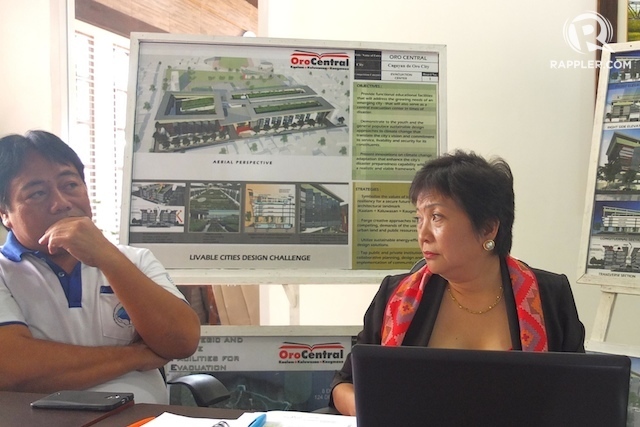
NEW CITY CENTER. Engineer Isidro Borja (left), Cagayan de Oro's top planning and development officer; and Eileen San Juan, the city's chief for Local Economics, Investment Promotion, discuss the planned Cagayan de Oro city expansion. Photo by Bobby Lagsa/Rappler.
NEW CITY CENTER. Engineer Isidro Borja (left), Cagayan de Oro’s top planning and development officer; and Eileen San Juan, the city’s chief for Local Economics, Investment Promotion, discuss the planned Cagayan de Oro city expansion. Photo by Bobby Lagsa/Rappler.

CAGAYAN DE ORO CITY, Philippines – Is there a looming battle over the use of the old Lumbia airport?
The national government is not the only one eyeing the old airport, reportedly for use by the US military under the Enhanced Defense Cooperation Agreement (EDCA). The Cagayan de Oro city government has also expressed interest in developing 106 hectares of prime airport property in Barangay Lumbia.
The city’s top urban planners, with the help of the United Architects of the Philippines, created the Planned City Expansion (PCE) in Barangay Lumbia, an expansive uptown village deemed suitable for expansion as it is not prone to flooding and has potential as the new city center.
Cagayan de Oro Mayor Oscar Moreno said the PCE was conceptualized under the United Nation Habitat’s Achieving Sustainable Urban Development (ASUD) project with the assistance of Arcadis, a global design, engineering, and management consulting company.
The PCE covers 820 hectares of land including the Lumbia airport which is now under the control of the Philippine Air Force’s 10thTactical Operations Group, though the land is owned by the Department of Transportation and Communications (DOTC).
New growth area
Moreno said that the prime land, which is 180 meters above sea level, is a strategic area since future expansions under the Mindanao Logistics Infrastructure network (MLIN) pass through or near lumbia.
The MLIN is a long-term development plan for the road network in Mindanao. It includes new construction, and the upgrade and improvement of existing national roads and local roads.
All agencies, including the Department of Public Works and Highways, should use the MLIN plan as a guide for their own long and medium term development plans in the area covered by the plan.
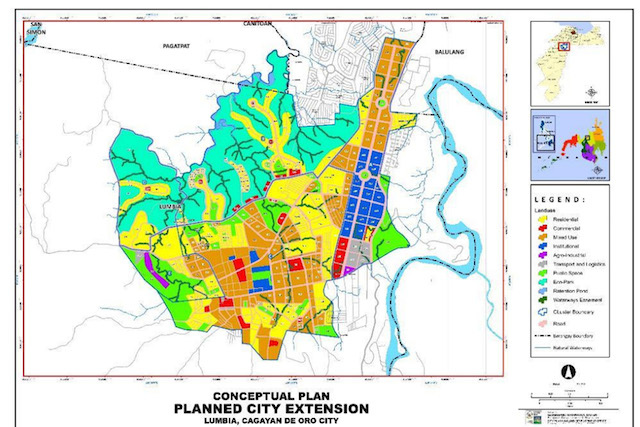
EXTENSION. The conceptual plan of the planned Cagayan de Oro city extension. Map courtesy of the CDO government
The MLIN is intended to be used as a reference for agencies involved in the development of the Mindanao transport network.
A new national road is being constructed that will connect Iligan City to Bukidnon.
Engineer Isidro Borja, chief of the City Planning and Development Office, said that the PCE will be the new growth area of the city with its cluster of areas for development.
“It is like a self-contained community where everything is there, without having to go to other places to work or study,” Borja said.
Last year, Christopher Rollo, ASUD country program manager for UN Human Settlement, said that if the expansion of the city is left unplanned and unchecked, it is likely to be driven by real estate market that favors development for the rich.
“In Lumbia, it is where everything can be put in place like public spaces can remain public, road network connected to other districts without being blocked by private ownership of lands,” Rollo said.
Mixed-use modern district
Eileen San Juan, the city’s local economics and investment promotions chief said that she met with defense officials on January 11, 2016, to present the city’s PCE, which includes the Lumbia airport.
Moreno said the PCE was presented to President Benigno Aquino III and Cabinet officials as early as 2013 as part of the city government’s bid to promote the city.
San Juan said that the PCE is an exercise in urban planning which the city badly needed.
Under the PCE, there are 5 proposed clusters – Lumbia airport is under Prime Cluster A where local and national government offices are located.
“We will also replicate ‘Plaza Divisoria,’ which is a unique feature not found in any other city,” San Juan said.
Plaza Divisoria is a strip of 5 parks with statue of national hero Dr Jose Rizal, Andres Bonifacio, president Ramon Magsaysay, and mayor Justiniano Borja who first planned the city’s business district which Divisoria will be part of.
San Juan said the city wants a strategic and sustainable development node, a model for adaptive reuse, providing rural areas easy access to economic opportunities and social services.
“We want an institutional landmark with wide public parks and open space in harmony with medium to high density residential and commercial development which would showcase the city for livability and resilience,” San Juan said.
Borja said the PCE conforms with the approved Comprehensive Land Use Plan (CLUP).
“With the diverse housing market, low, medium, high end suitability for resettlement, this project will answer the housing shortage in the city,” Borja said.
Clusters
San Juan said each cluster under the PCE is designed according to use.
  • Cluster A: Institutional and mixed use
  • Cluster B: Farmstead/homestead villages
  • Cluster C: Medium-density residential with community facilities, health and education, low intensity commercial area with at least 20% social housing with connection to town center and public spaces
  • Cluster D: Residential villages in terraced fields, water retention ponds, soil erosion control and tourism activities with ecotourism (biking, trekking, adventure sports), mountain view resort with convention and meetings facilities
  • Cluster E: Agri-processing Complex with waste management facility, mixed use Low–medium end housing, commercial, community facilities, value chain-considered efficient access to raw materials and markets

CLUSTERING. Cluster A is where local and national government offices would be located. Courtesy of the Cagayan de Oro city government

Borja said the PCE was designed considering road traffic. “All major roads will be 30 meters wide, while other roads will be at least 10 meters wide, both with provisions for pedestrian and cycling lanes.”
“We wanted the PCE is to be as walkable as possible; we want it to be environmentally and people friendly,” Borja added.
Adjustments
If EDCA enters into the picture and the airport is used by the US military, city officials said they would have to just adjust the design accordingly – but not without first exhausting efforts to convince the national government to favor the PCE.
Moreno said the long-term plan is for the common good.
“It is up to the national government if they’d allow the local government’s initial plan. We need them (national government) to cooperate because basically, the land belongs to to the Civil Aviation Authority and we cannot plan without them involved,” Moreno said.
Moreno added that the city government is taking steps to convince the national government on the expansion, as it is for the common good.
In its plan, residential areas will get 19.72% or 177.62 hectares; commercial area, 2.04% or 18.35 hectares; institutional 4.6% or 42.1 hectares; agro-industrial 2% or 17.87 hectares; mixed-used 15.8% or 142.9 hectares; commercial and transport facilities, 0.91% or 8.19 hectares; roads, 15.96% or 143.76 hectares; public spaces, 38.83% or 349.72 hectares.
“We will be expecting adjustments and needs to revisit the planning and resources needed to achieve our goal of the PCE,” San Juan said.  Rappler.com

Source: Bobby Lagsa/ http://www.rappler.com/nation/120224-battle-lumbia-airport-us-base-cagayan-de-oro-city-center

Affordable financing drives growth

“Housing demand is always determined by housing finance,” said Januario Jesus Gregorio Atencio, III, 8990 Holdings,Inc. president, in defending  developers’ need to have in-house financing for their projects. 

 Earlier, property consultant KMC-MAG expressed concern about the threat posed by developers’  focus on financing when their expertise is in construction. 

“When you build an econometric model for housing, on top of that is finance. The more accessible housing finance is, the more housing (projects) there will be,” said Atencio. 

“Finance is dictated by affordability. If housing finance is stopped, interest rates are high, entry requirements are high say at 20 percent down payment, then demand will be very small,” he added. 

Antton Nordberg, KMC MAG Group Inc.head of research, said apart from finance not being a core competency of developers, there is also no clear picture on the size of the in-house financing market which remains unregulated. 

“Overall, it’s been increasing quite fast,” he said, noting  the Central Bank’s policy to scale back bank’s lending activity may have also contributed to the rise of in-house financing. 

“Why this is a problem (is because) developers’ core expertise is not necessarily in the financing of products but rather in the development. So there might be some serious underestimate(ion) in the credit worthiness of the home buyer since (this is)  more of risk management than project development,” he added. 

Nordberg, however, was quick to point out that the risk is not an immediate threat. Still this could pose a problem should some external shocks arise. 

“It’s not really an issue right now but if there are some external shocks, it might cause some problem,” he said. 

Atencio said while developers should not be bankers, as KMC-MAG, they will undertake initiatives  to move housing forward. 

Atencio said state-housing fund Pag-IBIG had been successful in lowering the cost of housing for buyers through lower interest rate and lower premiums, making housing more affordable,” 

By ALBERT CASTRO/January 28, 2016/ http://www.malaya.com.ph/business-news/special-features/affordable-financing-drives-growth
Affordable housing finance remains a key in propelling the growth of the housing sector. 

Thursday, January 21, 2016

PROPERTY SECTOR GROWTH SLOWDOWN SEEN

Brokerage firm Colfinancial.com  sees a slowdown in the property sector in 2016 after years of robust expansion.

The online brokerage firm noted this is particularly true in the residential market.

“Take-up sales of residential properties continue to grow annually. However, the pace of growth has been slowing down since 2014 given the high base effect,” it said. 

“This year, we expect growth to remain slow as take up sales in 2015 remain substantial. Aside from high-base effect, as risk to growth this year is the slowing growth of OFW remittances,” it added. 

Colfinancial.com noted that in the first 10 months of last year,  remittances from overseas Filipinos increased by only 3.7 percent to $20.6 billion from an average of around 7 percent in the past five years.

 This should a big consideration in the property market, according to the brokerage firm, given that the average contribution of OFW sales to take-up sales is around 31.5 percent. 

“Another possible, albeit small, risk to demand is higher interest rates. Local bond yields have increased following the rate hike by the Federal Reserve of the United States in December of 2015 and
expectations of more rate hikes,” Colfinancial.com said.

 “However, according to our banking analyst, lending rates are not expected to mirror the increase in bond yields due to ample liquidity conditions and intense competition among banks. Moreover, the Federal

Reserve has repeatedly said that the rate hike cycle will be slow,” it added.

 Colfinancial.com said any increase in lending rates will be very small and not enough to significantly dampen demand for real estate. 

The brokerage firm also assured that the risk of a glut is low.

 “For the first nine months of 2015, takeup sales of leading property developers outpaced launches. This indicates that sales are not primarily driven by new launches and that there is enough demand to
absorb developers’ existing inventory. This also indicates that developers are disciplined enough to continuously monitor the demand- supply situation and are careful not to flood the market with supply,” it
said.

 The office space segment meanwhile continues to benefit from the good prospects of the business process outsourcing sector. 

“The depreciation of the peso last year also gives international companies greater incentive to move backroom operations to the Philippines,” it added. 

Colfinancial.com said the growth in demand will be able to absorb incoming supply. 

“According to Colliers, office supply will grow at a CAGR (compounded annual growth rate) of 8 percent from 7 million sq uare meters in 2014 to 9.5 million sqm by 2018. Meanwhile, IBPAP (Information

Technology Business Processing Association of the Philippines)  expects the BPO (business process outsourcing) sector to have 1.3 million full-time employees by 2016, up by a CAGR of 14 percent from 1 million in 2014,” it said.

 “Even if growth rate of full-time employees drops to half in 2017 and 2018, we believe it will still be enough to fill the incoming supply,” it also said.

 Colfinancial.com meanwhile said outlook for the commercial leasing segment remains positive as retailers continue to expand, creating demand for retail space. 

“The improvement in the economy is also resulting to an increase in the number of casual dining outlets. Economic growth and stability has led to the increase in the frequency of people dining out rather than
eating at home, thus creating demand for more casual dining outlets. This serves as a big driver of demand for commercial space,” it said. 

“With this in mind, we expect vacancy rates to remain low and same store/ mall sales to remain on an upward trajectory,” Colfinancial.com added.

Source: By ALBERT CASTRO  / http://www.malaya.com.ph/business-news/special-features/property-sector-growth-slowdown-seen

Monday, March 19, 2012

BIR interactive form 1702

Monday, March 19, 2012

THE Bureau of Internal Revenue (BIR) has released the Interactive BIR Form 1702 (Income Tax Return for Corporations and Partnerships) which allows users to insert data, edit, save, and print the form.

The interactive form does automatic computations and can print the income tax return which you will file with the accredited agent bank (AAB) or revenue collection officer (RCO) when you pay your income tax due on April 16, 2012 (since April 15, 2012 falls on a Sunday). For those with zero tax payable, the ITR and its attachments can be submitted to the Revenue District Office (RDO).

To open the interactive form, use of PDF-XChange Viewer is required. A link is available in the instructional guide to download the program for free. PDF Acrobat Reader will only allow you to view the Interactive Form, edit and print but not save the form.

According to the instructional guide, eFPS filers should file manually without need for prior approval while the new form is not yet available in the eFPS. Once the eFPS is ready, eFPS filers will need to refile electronically.

For a copy of the BIR Interactive Form 1702 and instructional guide, you may visit the BIR Forms section of the agency’s official website – www.bir.gov.ph.

Tuesday, February 14, 2012

City eyes P8B coastal dev’t

By Justin K. Vestil

Tuesday, February 14, 2012

THE Mandaue City Government wants to turn at least 130 hectares of its coastal area into a Global City.

A private port operator from Metro Manila will help City Hall figure out if that plan is feasible at all.

Check what's new in CEBU Now, click here

Mandaue City Mayor Jonas Cortes and Harbour Center Port Holdings Inc. (HCPHI), represented by Dr. Michael Romero, signed a memorandum of agreement yesterday that will bind HCPHI to conduct a feasibility study in the next three to six months.

Romero, in an interview with reporters, said they are proposing to develop coastal areas from the Cansaga Bay Bridge to the North Reclamation Area (NRA) into a mixed use
zone.

He said they found Mandaue City to be viable as a commercial and industrial gateway to Cebu. With the Global City Mandaue project, they said they can turn the city into the premier commercial and industrial city in Cebu, with a harbor industry as vibrant as that of Hong Kong.

Romero revealed that the project, after feasibility study, will undergo four phases, with commercial development and logistics pursued in the first two phases.

The third phase involves turning some parts of the development into residential areas, while the fourth phase is the preparing buffer zones for mangroves.

Mayor Cortes, in a separate interview, told reporters the project will speed up Mandaue City’s development and make the most of its strategic location.

They are estimating the project to cost about P8 billion to P9 billion, and said it may be finished by 2016.

Although it will be done at no cost to the City Government, the feasibility study will cost HCPHI about P140-P150 million, Romero said.

HCPHI is the holding company of the Romero family for its port operations and currently runs the Manila North Harbor and Harbour Center.

Also yesterday, Business World reported that a joint venture between Romero’s group and San Miguel Corp. intend to spend P2 billion this year to repair the Manila North Harbor’s platform and pier.

Published in the Sun.Star Cebu newspaper on February 14, 2012

Sunday, February 5, 2012

P3B set aside for 3 ventures

By Katlene O. Cacho

Sunday, February 5, 2012

HOMEGROWN developer Cebu Landmasters Inc. is earmarking P3 billion for capital expenditures starting this year, for the development of three residential projects in Cebu under a joint venture with RDAK Transport Equipment Inc.

Cebu Landmasters Inc. president and chief executive officer Jose Soberano III said the programmed capex will stretch until 2014.

Learn what's new in Cebu now, click here

The company broke ground last Saturday on its first residential project, Midori Plains, in partnership with RDAK.

The project, which sits on eight hectares in Tungkop, Minglanilla, will house an initial 387 residential units with prices ranging from P1.6 million to P3.2 million.

Average lot area is 120 square meters.

Midori in Japanese term means “green.” Soberano described the project as an Asian-inspired, Zen-living development.

“The partnership of this project came in when I learned that RDAK and Cebu Landmasters are both eyeing the same property in Minglanilla. So we decided to work on the project together rather than compete with each other,” Soberano said, adding that this project is RDAK’s first venture in Cebu’s thriving real estate industry.

Branching out

RDAK’s core business is in the transportation and heavy equipment industry, which includes manufacturing and selling of several types of heavy, light and medium transport vehicles.

Ricarido Delfin Abellana King, founder and owner of RDAK Transport Equipment Inc., said their venture into property development signifies their optimism and confidence in Cebu’s real estate industry.

The two companies will pour in P500 million to develop Midori Plains, which will have nine house designs intended for the middle-class market. The firm also allotted some 50 lot-only units.

Midori Plains land development is expected to be completed within one year.

Among the amenities are Club Chi, which features a swimming pool, open-air pool cabanas, function hall and entertainment rooms; and a gazebo.

Aside from Midori Plains, Cebu Landmasters and RDAK are also set to develop two condominium buildings on A.S. Fortuna in Banilad and on Salinas Ext. in Cebu City.

According to Soberano, the A.S Fortuna project will have two 12-storey condominium buildings with 198 units each. This condo project is being pitched to the middle-class market, such as young professionals, with unit prices ranging from P1.3 million to P1.6 million.

The Salinas project, on the other hand, will have seven mid-rise condominium buildings with a total of 1,200 condo units. This project is programmed for a three-year development.

According to Soberano, the low interest rate, strong domestic liquidity, huge housing backlog and strong inflows of remittances prompted them to be aggressive in building property projects in Cebu.

Familiarity

Cebu, he said, has always been a hub for work and education.

He added local players like him are not threatened by the coming of big players in Cebu, as the province records a huge housing backlog.

“They may have dominance in certain markets but local developers here have a good head start in the real estate environment because of our familiarity with local conditions,” he said.

His company, for instance, is eyeing the middle market who can afford to acquire houses with prices ranging from P1.5 million to P3 million.

Cebu Landmasters’ first residential project is San Jose Maria Village in Balamban in 2003. Since then, he brought the brand to different areas such as Minglanilla in 2007, Toledo in 2009, and Talisay in 2010.

The company made its first foray into vertical development with the 17-storey high-rise condominium project called Asia Premier Residences at the Cebu I.T. Park (formerly Asiatown I.T. Park). This was followed by the construction of the 18-storey residential condo the Baseline Residences along Juana Osmeña St. last year.

Soberano said there are more residential subdivisions being eyed by the firm in Tagbilaran, Cagayan de Oro, and Ilo-ilo cities, as part of their positioning to become a significant community developer in the Visayas and Mindanao. For more information, contact us at +63917.3236123 | +63922.8236123.

Published in the Sun.Star Cebu newspaper on February 06, 2012.

Ordinance to grant tax incentives for organic farming


2/6/2012

A PROPOSED ordinance granting five to 10 percent discount in real property taxes for farmers practicing organic farming in Cebu will be deliberated today in the Provincial Board (PB).

PB member Arleigh Sitoy said his ordinance granting incentives to organic farms is now up for second reading in today's PB session.

Once approved, the measure will be elevated to third and final reading prior to approval.

The draft ordinance will allow accredited farmers, using “organic” methods to avail of discounts in real property taxes collected by the Capitol.

Learn what's new in Cebu now, click here

The farmers will be accredited by the Department of Agriculture regional office 7 which created a special committee that will evaluate and determine if the farms use only organic fertilizers.

“Not all farmers can avail, only those that use organic (fertilizers),” Sitoy said in a phone interview yesterday.

Sitoy said the land being used should also be classified as agricultural lands.

Sitoy said it would encourage farmers to continue practicing organic farming and produce natural food free of genetically modified organisms (GMO).

“This is also environment-friendly,” he said.

The proposed ordinance is in support of a national law which allows local government units (LGUs) to grant tax and other incentives to farmers using organic farming methods.Reporter Dale G. Israel

Friday, February 3, 2012

S'pore ranks 3rd for ideal home among expats

Singapore has been ranked the third most ideal place to live in due to its quality of life and career opportunities, according to HSBC’s Expat Explorer survey.

More than 3,000 expatriates from over 100 countries rated locations on a range of criteria, from food to accommodation, healthcare, transportation and work.

Nine percent of the respondents believe that Singapore combines the best of both worlds, highlighting its prime job opportunities along with good quality of life.

Meanwhile, Australia took top spot, with 10 percent of respondents preferring to live and work in the country, famous for its sun-drenched beaches and solid economy.

Learn what's new in Cebu now, click here

“The report suggests expats are putting lifestyle and well-being ahead of money and Australia wins hands down on this front,” said Graham Heunis, Head of Retail Banking and Wealth Management at HSBC Bank Australia.

With only a slight difference in votes, the United States came in second, and was perceived to offer the best career opportunities with higher remuneration, said the report.

Hong Kong took fourth place, followed by Canada, the United Kingdom and France. Respondents revealed that they were drawn to Hong Kong’s high income, while the UK and Canada were picked by expats due to lifestyle.

Taxable properties total: P25B

By Princess Dawn H. Felicitas

Saturday, February 4, 2012

REAL property taxes in Cebu City may double next year once the City Assessor’s Office finishes the tax mapping and revalidation of real property (RPU) units in the city.

City Assessor Eustaquio Cesa said they were able to assess 212,315 RPUs in the city from January to December last year, as well as 12,780 RPUs that are exempted from taxes.

Learn what's new in Cebu now, click here

The total assessed value of taxable RPUs totaled to at least P71.8 billion while the value of non-taxable RPUs totaled to P46.5 million.

Cesa said non-taxable RPUs include government offices and buildings, schools and churches.

Based on the records of the assessor’s office, the number of RPUs from last year has increased from 205,892 in 2010 with an assessed value of P47.8 billion as well as the number of RPUs that are exempted from taxes that totaled 12,780 with an assessed value of P24.3 billion.

The amount of taxable properties this year totaled to P25.2 billion.

Double

Cesa, in a news conference yesterday, said the amount could double by next year and reach P50 billion once the tax mapping and revalidation of real properties in the city will be fully implemented.

An increase in the amount of taxable properties would also mean an increase on the real property tax collection of the City Government, he said.

To compute for the real property tax, the assessed value of the property should be multiplied by the rate of basic real tax which is pegged at not more than one percent for the provinces and not more than two percent for cities.

Assistant City Assessor Liezel Gonzaga said they have started tax mapping and revalidation of real property units last month using their P20.1-million approved budget for this year.

Gonzaga admitted that their progress in implementing the program will be slower, considering that their proposed budget of P2.4 million to buy vehicles was not approved.

Gonzaga said only P8 million out of the P25 million budget has been approved by the council.

The amount is supposed to be used to hire 90 job order personnel, whose salary will cost P3 million, including for training and to buy IT equipment.

Published in the Sun.Star Cebu newspaper on February 04, 2012.

Ceboom architect still upbeat,cites how Cebu can keep lead

Saturday, February 4, 2012

Pachico A. Seares
Seven Questions

1.) You’re known as the architect of Ceboom, when Cebu’s economic strides first caught the attention of the nation and the world. Much of what Cebu is today economically may be credited in a large part to the foundations laid when you were governor of the province. Do you see Cebu’s growth to continue or do you see the threat of a bubble bursting, such as the collapse of the call center industry and oversupply of condos, hotels, and other housing units? Tell us how Cebu can still survive and prosper despite any turmoil in the economy elsewhere.

Have something to report? Tell us in text, photos or videos.

Historically, the Bisaya tribes had a more advanced civilization than the rest of the archipelago. Before the Hispanic conquest we already had a written language. We were garbed in silk and cotton because of the trade with as far as India and China.

Learn what's new in Cebu now, click here

We were building more efficient and larger seacraft than the Spanish: the flagship of the Spanish armada that was named “El Galleon de Manila” was built in Cebu. The main reason the Visayan group was better developed than the two other major islands, Mindanao and Luzon, was because all transportation at the time was by sea and collectively the Visayan group has more shoreline, which made the agriculturally-rich coastal areas in the largely agricultural global economy much more productive and convenient.

Cebu’s safe harbor with the protection of the island of Mactan and its central location from northern Mindanao to the Visayan islands and the Bicol region in Luzon are decidedly huge advantages.

Cebu became the only transshipment point in the archipelago and eventually the trading capital for goods from China and India on their way to Malaysia and Indonesia.

In the accounts of the Spanish Scribe Pigafetta, the Spanish fleet was led to Cebu and Magellan decided to establish what he hoped would become the lead colonial capital in Cebu, making the so -called Christian monarchy the lead monarchy over all the other neighboring kingdoms.

He was slain by one of the kings or chiefs of the island of Mactan, Lapulapu, which shortened the stay of the Spaniards.

It is important to note that when the Spanish departed to complete the circumnavigation, they sailed to Brunei another trading point, New Guinea, and then sailed through Sumatra on their way to the Malaccan Straits, which indicated the trade network of Cebu. It is obvious therefore that the skill of the Cebuanos was already there before the Spanish came.

After the suppression of the Marcos dictatorship which Cebu never did accept, my governorship came two years after Edsa 1 and gave the Cebuanos the breath of oxygen that revived free enterprise and the potential for optimizing productivity.

My governorship considered the scarce resources and provided M2, the velocity of movement of money, people, goods and services. I prioritized what I called the four pillars for progress.

Power, water, transportation, and communication were laid in Cebu ahead of the rest of the country and the money came from sourcing revenues from thinking out of the box such as the first and only successful municipal bond issue partnering government with the private sector.

The CPVDC, privatization of the Naga power-generation plant, establishment of municipal telephone systems, aggressive and accelerated municipal water systems, cementing of major roads to include even national roads with local funding (unheard of in this country to this day), and organizing and providing task forces for building f farm–to-market barangay roads. This infrastructure provided quality of life that has made Cebu favorite of foreign investors, and, most important of all, zero tolerance to graft! As you can now well see, all this inevitably led to higher employment.

Because of better peace-and-order situation, availability of the improved infrastructure, a higher quality of life, and, more importantly, the supply of skilled, educated, reasonably priced services, people with the right working attitude, Cebu has attracted direct foreign investments. These investors whose propensity to invest with discretionary cash do not affect our local money supply. As the Asian economies grow, foreign investment will accelerate and continue to contribute to our local economy. The mushrooming of high-rise dwelling units, hotels, and BPOs is only the tip of the iceberg. This is the Asian Century.

2.) You have projected an image of being a visionary by the bold steps you took when you led Cebu. You had a lot to do with the transfer of the airport and the building of the second Mandaue-Mactan bridge, the construction of the trans-central highway, the sale of province lots that led to the Ayala Business Center which in turn spawned other malls and business sites, and so forth and so on. What moves do you see from present leaders that you consider similarly visionary?

The most notable would be the South Road Properties of Tomas Osmeña, the dancing provincial inmates of Byron Garcia, and the fast ferries.

What is essential for our future growth, since we sit at the center of north and south America, Australia, Japan, China and Asean, is a destination/transshipment air and sea port not yet existing in the Philippines. A destination port should be able to handle mega container ships and mega tankers that have a maximum of draft 50 feet. An international destination/transshipment airport should have multiple runways and a major cargo handling facility.

In order to support this growth we need a non-stop light coastal highway, passing all towns from Daanbantayan to Santander, which is affordable and doable immediately.

Secondly a rapid transit system along, under, or over the old railway from Danao to Argao. Very few people realize that by cutting travel time around Cebu by half, we will multiply our wealth (again the M2 effect). It will mitigate our water supply problems and cut transportation cost. It will increase the value of real estate and enable affordable housing for the working class.


3.) What do you see as right or wrong in the way City Hall and Capitol have been run for the past decade?

There may be techniques of governance the present leaders may have missed, or are power rivals just mired in too much politics?

A short, short answer: too much egoism results in obstructionism at the expense of the people.

4.) There’s still an Osmeña in the Senate (Serge) but Osmeñas in Cebu City seem to be running out of leadership material, with its once deep bench reduced to Tomas Osmeña, who’s ailing, his wife, and probably their son. In the province, the Osmeñas have virtually disappeared with only Sonny Osmeña planning a comeback as congressman and your son Mimo eyeing the Talisay City mayor’s seat or the House post.

Is the imminent exit of the Osmeñas still reversible? Lack of young leaders in the clan is a factor but inability of the Osmeñas to unite among themselves may also be a reason.

Cebuanos despaired when the first Osmeña hero on record, Guillermo, was banished from Cebu in 1850 and the Parian church, which he defended, was demolished by the Peninsulares. Little did they know that he left an offspring that would end up being the father of Philippine independence a century later: Sergio Osmena Sr.

Not to worry -- a few dozen fourth-generation Osmeñas from Don Sergio are coming soon.

5.) As founder of Promdi (Probinsiyano Muna Development Initiative) under which you ran for president, what did that campaign instruct about galvanizing the Bisaya vote into a potent national or regional political bloc? Can it ever be done, perhaps by another Cebuano leader?

I certainly hope so. We should learn from the Bicolanos and Ilocanos, that’s why they are so well-represented in the national government. However, as happened in many countries in the world, when central imperial powers declined, regional powers grew. Maybe our target should be more autonomy. “Promdi” can easily be achieved through people power.

6.) You’re a staunch believer in, and passionate advocate for, Cebu. Slogans and catchprases you’ve used (Ceboom, “an island in the Pacific,” Promdi, and, lately, Sugbo Labao Kanatong Tanan) proclaim the strength of Cebu, the Cebuano, and, by extension, the “promdi.”

Do you think the advocacy is still valid nowadays when insularism has given way to primacy of national concerns and globalization?

Precisely because of modern technology, the value of the individual in his ability to communicate with the entire world with the touch of a screen, communities of common interest, language, culture, and beliefs can now organize easily and freely.

Consequently we can now demand what we are deprived of: respect for our language, return of our taxes, and equal representation or the right of self-determination.

7.) Looking back, what do you consider as the more satisfying achievements of your career in public service, as governor and presidential chief economic adviser?

I am proudest at having caused employment of the greatest number of Cebuanos. As governor, I had made our people believe in themselves, happy, and productive.

As presidential chief economic advisor, I oversaw the initiation of the four pillars for progress, so successfully implemented in Cebu and, this time, nationwide.

Published in the Sun.Star Cebu newspaper on February 04, 2012.

OTHER LINKS